Menu Close

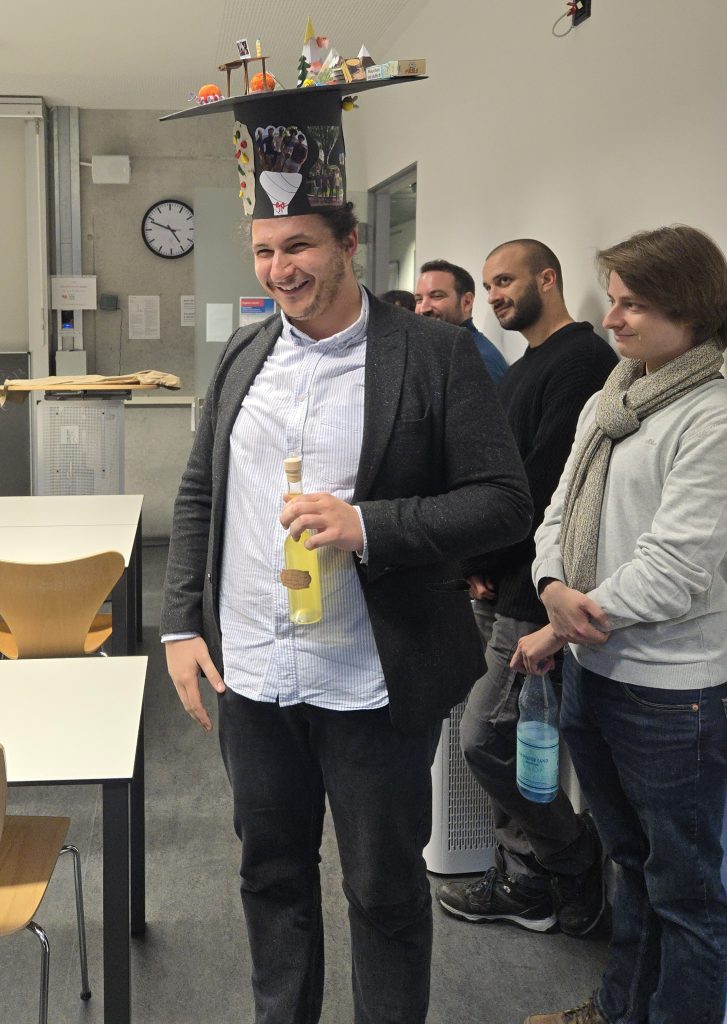
Congratulations to Carlo Musolino, Harry Ho-Yin Ng and Konrad Topolski for successfully finishing their doctoral studies!

Over the past years, the JETSET group has grown not only through new ideas and results, but also through the people who carried them forward day after day. We are proud to celebrate a special milestone: three PhD researchers in our group have successfully completed their doctoral studies: Carlo Musolino, Harry Ho-Yin Ng and Konrad Topolski.
Their work represents years of curiosity and persistence and has made a lasting contribution to the scientific goals of the ERC JETSET project.

During their PhDs, they worked on complex questions at the intersection of theory, computation, and astrophysical phenomena, pushing the boundaries of our understanding of relativistic jets and multimessenger astrophysics. Beyond their individual research achievements, they played an essential role in shaping the collaborative spirit of the group — mentoring younger students, contributing to the development of shared codes and ideas, and participating in projects that strengthened the project as a whole.

Carlo Musolino’s reseach focused on the impact of neutrino radiation on the post-merger evolution of binary neutron stars, demonstrating through long-term general-relativistic magnetohydrodynamic simulations that neutrino transport can the emergence of magnetically driven, collimated outflows. He also demonstrated that fallback accretion onto merger remnants can power long-lasting high-energy emission, offering a compelling explanation for the extended emission observed in short gamma-ray bursts. His work advanced our understanding of the interplay between neutrinos, magnetic fields, and jet-like structures in merger remnants.

Harry Ho-Yin Ng extended neutrino transport beyond the standard framework by incorporating muonic degrees of freedom in fully relativistic merger simulations, showing that muonic weak interactions lead to cooler remnants, more neutron-rich ejecta, and substantial changes in r-process nucleosynthesis yields. His work highlighted the importance of previously neglected microphysical processes for accurately modeling post-merger dynamics and heavy-element production. He further showed that magnetic buoyancy (the Parker instability) can drive episodic flares and sustained, jet-like outflows from long-lived merger remnants, linking post-merger magnetic evolution to observable high-energy emission .

Konrad Topolski’s research explored black hole–neutron star mergers across a wide range of mass ratios and black-hole spins, systematically identifying the conditions that separate direct plunge from tidal disruption. By combining quasi-equilibrium predictions with high-resolution dynamical simulations, his work established robust criteria for disk formation, gravitational-wave signatures, and the potential for electromagnetic counterparts in these systems, providing essential insights for multi-messenger astrophysics. He also showed that key features of the post-merger gravitational-wave spectrum follow quasi-universal relations, enabling more precise constraints on neutron-star matter from GW observations.

As they now move on to the next stages of their scientific careers, we would like to thank them for their dedication, creativity, and the energy they brought into JETSET. We wish them curiosity, courage, and success in whatever challenges lie ahead.